How a pack and play works
The fold that fights you is the smartest thing in the nursery. This is the hidden latch inside every top rail, the forty-year story of how it got there, what more money actually buys, and which model deserves a spot in your trunk.
Based on months of daily use of our own unit, the public recall record, and the current federal safety standard for playards.
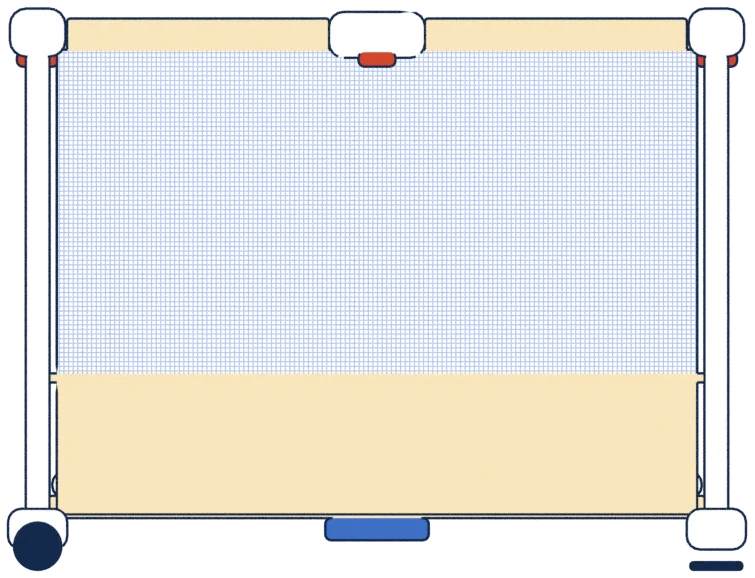
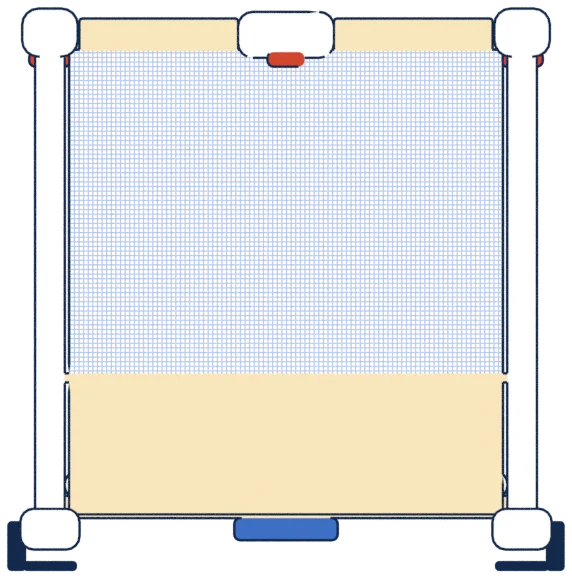
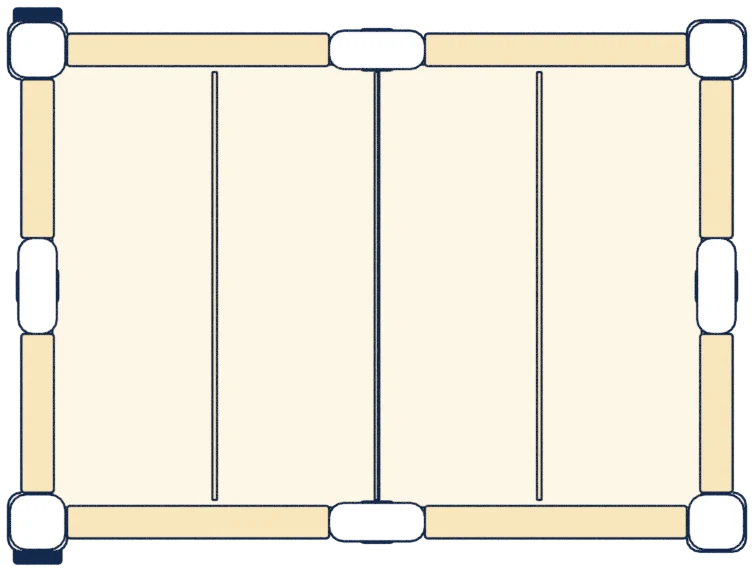
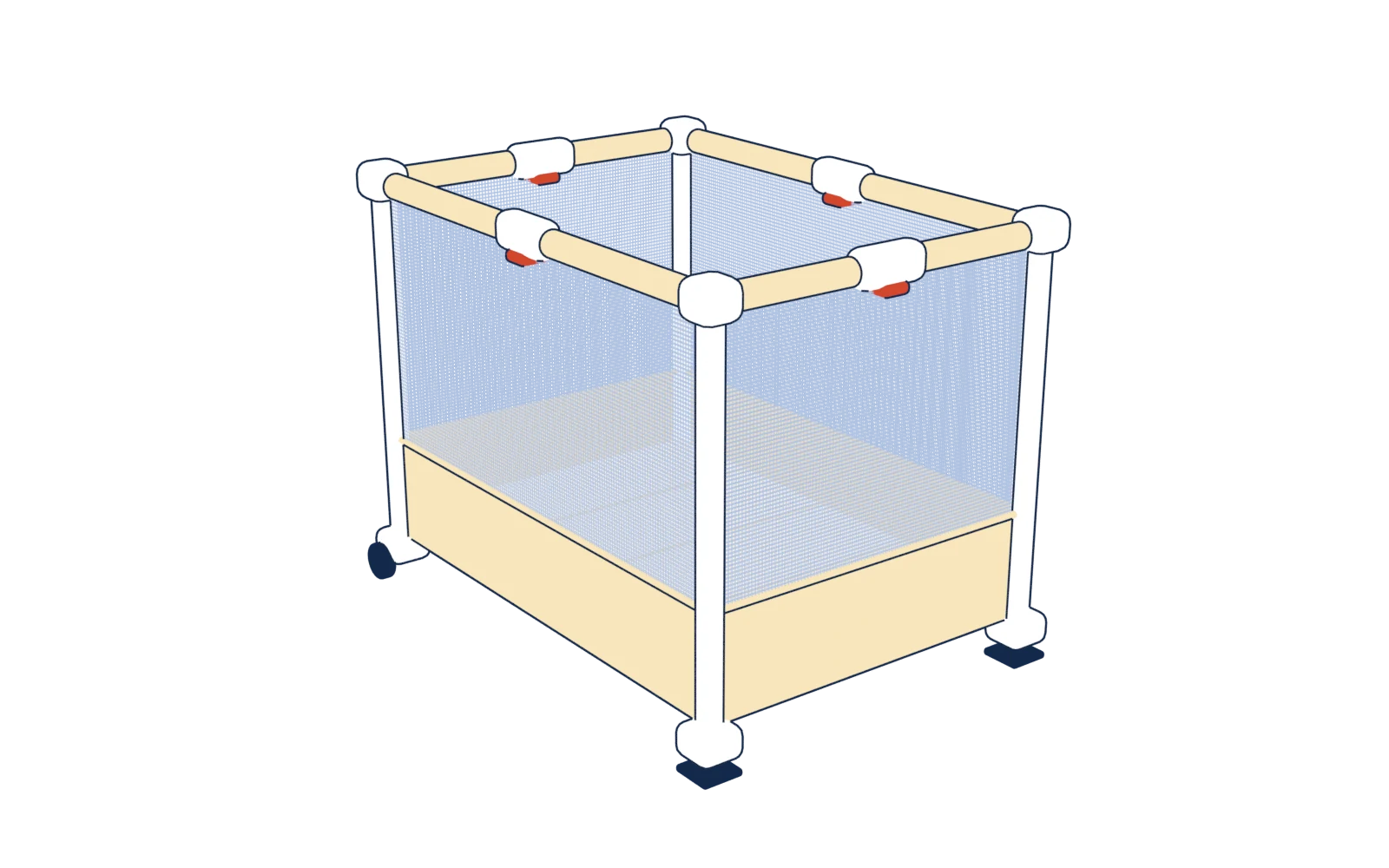
The 3D model didn't load in this browser, so here's the short version: the rails will not unlock until the floor is lifted, and that's deliberate.
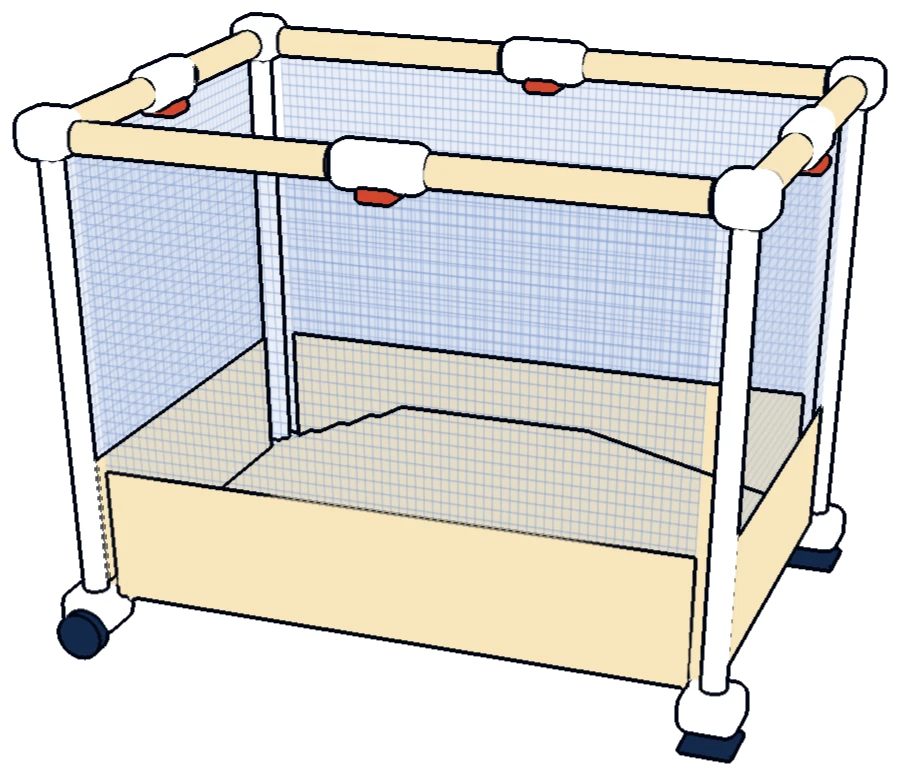
All set up and locked. All four rail hinges are seated. Try squeezing the rail buttons first and see what the frame does.
- Top rail, in its fabric sleeve
- Center hinge, where the lock lives
- Release button, the part you squeeze
- Floor hub, hidden under the mattress
- Netting wall
- Wheels, on one end only
- Detail A, inside the hinge
Read this first
The rails lock themselves. You can't get a rail straight without also locking it. That's the design, not luck.
See it in Detail A ↓The fold starts at the floor. Lift the center of the floor first. Until you do, no amount of squeezing the rail buttons will work.
Try it in Fig. 1 ↑You can't buy more safety. Every playard sold in the US passes the same federal standard. Extra money buys a nicer mechanism, lower weight, and smaller packed size.
Compare the price bands ↓Match the model to the moves. One room: buy basic. Daily moves: buy the one-hand fold. Flights: buy a travel crib, a genuinely different machine.
Jump to which one to buy ↓
The machine, in five parts

How the lock works
The rail locks itself
Each top rail is two tubes meeting at a hinge 12, and inside the hinge is a spring-loaded latch built around a rotating piece called a cama. Straighten the rail during setup and the cam tips over its peak and drops into place with a click you feel through the tube more than hear. You can’t get the rail straight without locking it. That’s half the safety story.
The floor clamps it shut
The other half hides in the floor. Pressing the center hub down pulls all four corners inward and squeezes every rail along its length, and the latch is shaped so the squeeze clamps it shut. Pressing the release buttons 14 does nothing while the floor is down, no matter how strong you are.
You aren’t fighting a spring. You’re fighting the whole assembled frame, and the frame always wins.
The fold, in order
The sequence is enforced by the shape of the parts, so learn it once and it never changes. And if you push the floor down before all four rails have clicked during setup, you’ve clamped four half-locked hinges that can’t finish locking and can’t release either. The fix is always the same: floor up, let the rails click, floor down. The playpen was never broken. It was waiting for you to do the steps in order.
 Lift the floor hub by its strap
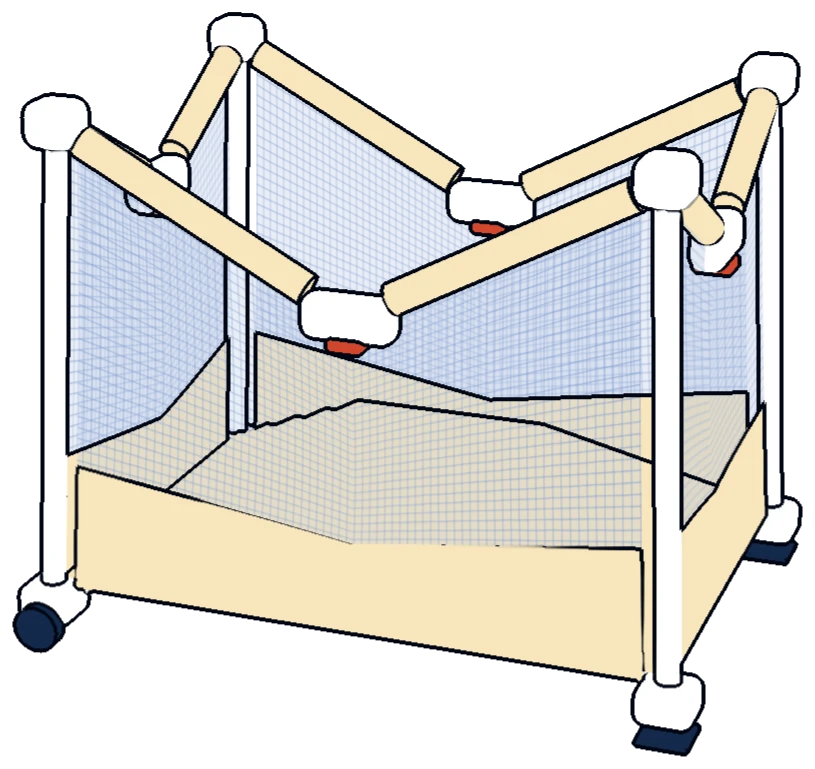
 Squeeze the rail buttons
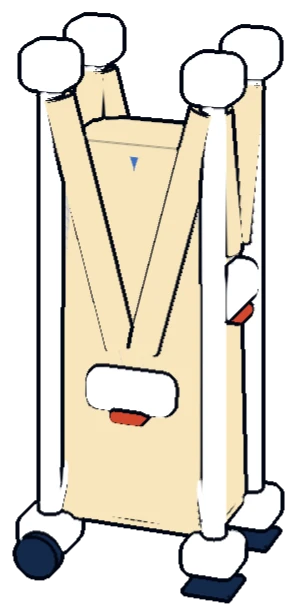
 Bring the frame together
Where it came from
The pack and play didn’t start as a travel product. It’s the third act of a much older object, and the fold that frustrates you is the newest part of the story.
- Most of the 1900sThe playpen is furniture: a heavy pen of wooden slats that lives in one room of the house. It doesn’t fold, doesn’t travel, and doesn’t collapse, because it can’t do anything except stand there. Portable, for most of the century, means it has casters.
- 1987Graco launches the Pack ’n Play, designed by Nate Saint, whose father invented Graco’s first baby swing. Folding rails and a collapsing floor turn the room-sized pen into a duffel bag, and the category explodes: one design eventually reaches tens of millions of homes, and “pack and play” becomes the generic word the way Kleenex did.
- The catchA structure that can fold is a structure that can collapse. Early portable cribs across the industry used rotating top-rail hinges you twisted by hand, and nothing about them told you whether you’d twisted far enough. A rail that wasn’t fully rotated could hold its shape for hours and then fold without warning into a Vb, with the child inside it.
- 1993The Playskool Travel-Lite is recalled after three infant deaths caused by its rotating top-rail hinges, roughly 11,600 units. Recalls only ever reach a fraction of the products already in homes, so the deaths continued in secondhand units for years. Regulators eventually counted around fifteen deaths across brands using the same style of hinge.
- 1998Danny Keysar, a Chicago toddler, dies in a recalled Travel-Lite at his licensed daycare, five years after the recall. His parents found the child safety organization Kids In Danger.
- 2008The major consumer product safety law passed that year includes a section named for Danny, turning the industry’s voluntary playpen standards into federal law.
- TodayThe rules require exactly what you worked through in Fig. 1: rails that lock themselves during setup with no step an adult could forget, and a release that takes deliberate, two-part effort that neither a curious toddler nor a distracted grown-up leaning on the rail could manage by accident.
Living with ours
Ours has been in continuous service since our son arrived. What months of daily use teach you that the box never mentions:
- The lock really is silent. The latch settles with something you feel through the tube rather than hear, and nothing on the product shows whether a rail is locked. I check by pressing down hard on the middle of each rail after setup, which is close to how the testing labs verify it, minus the calibrated equipment.
- The thin mattress is deliberate. A firm surface protects babies from suffocation, and thinness matters too: a thicker pad raises the floor, and a raised floor plus a climbing toddler equals an escape ramp. The plush aftermarket mattress in your cart defeats both protections at once.
- The carry bag is the weakest link. The fold produces a slightly lumpy bundle and the bag was sewn for a perfect one, so bagging the frame takes more effort than the fold itself.
- The handle is just webbing. All twenty pounds of folded frame hang from a strap edge a few millimeters wide, digging into your fingers the entire walk to the car.
What I'd change
None of these would add more than pennies to the build cost.
- Little lock windows. A small window in each hinge showing a green flag only when the latch is fully seated would end the press-down test overnight. One molded part and one spring per hinge, and half the strollers at the playground already have exactly this.
- Print the order on the thing. A woven tag on the hub strap saying lift the floor first, and the word squeeze on the rail buttons. The frame already enforces the sequence. It could at least admit the sequence exists.
- A real handle. A molded grip over the webbing loop, the kind every tote bag figured out decades ago.
What I wouldn’t touch: the interlock, the silent stubbornness, the thin mattress. Anything that makes this easier to fold also makes it easier to collapse, and the frustration is honestly load bearing.
What more money actually buys
Since every model passes the same federal tests, the price ladder is really a parts ladder. You’re not paying for more safety, you’re paying for a nicer machine. Here’s what actually changes as the number goes up.
Basic tier
- Frame: steel tube, the heaviest option at about 20 pounds, with four separate rail buttons you work by hand.
- Fold: the classic two-hand sequence from Fig. 1. It works forever, it just makes you learn it.
- Fabric: thinner mesh and covers. Fine for one spot at home, shows wear faster if it travels.
Mechanism tier
- Frame: more aluminum, beefier hinge housings, and the four rail buttons replaced by one central linkage.
- Fold: one push on the hub does everything, because the lock lives in a single central mechanism instead of four separate hinges. This is the whole reason the tier exists.
- Weight: often heavier, not lighter. The 4moms Breeze is about 30 pounds. You’re buying convenience per fold, not portability.
Travel tier
- Frame: aluminum scissor legs with stretched fabric instead of folding rails. There are no rail buttons at all.
- Fold: seconds, into a backpack or a flat slab. A genuinely different machine that happens to pass the same playard standard.
- Weight: about 13 pounds, the entire point. You pay for lightness and packed shape, not padding.
Which one to buy
The right choice depends entirely on how often the thing moves.

Graco Pack 'n Play
- Weight
- About 20 lb
- Fold
- Buttons + hub, two hands

4moms Breeze
- Weight
- About 30 lb
- Fold
- One push, one hand

Guava Lotus
- Weight
- About 13 lb
- Fold
- Scissor legs, backpack

BabyBjörn Travel Crib Light
- Weight
- About 13 lb
- Fold
- Legs scissor flat